
Miami Beach Senior High
Hall of Fame 2000 Inductees
The 7 inductees honored at the 2000 Hall of Fame ceremony — distinguished Beach High alumni recognized for excellence in their fields and contributions to the community.
Clark "Doug" Burris (in memoriam)
Faculty 1972-2013 · Education/Music: Rock Ensemble Founder, Teacher
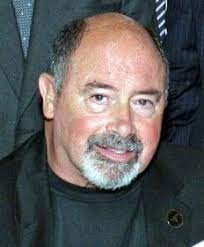
Miami Beach High music teacher Doug Burris became a father figure to generations of students through his teachings of rock 'n' roll. His legacy of inspiring students was so profound that last year, the City of Miami Beach named the North Beach Bandshell stage the Clark Douglas Burris Stage. Notable alumni of his class include familiar locals such as Rachel Goodrich, Deaf Poets' Sean Wouters and Nicolas Espinosa, Alex Gimeno (AKA Ursula 1000), and Exposé's Ann Curless. The ensemble has won accolades in national competitions and has earned a plaque from the Rock and Roll Hall of Fame, where the group once performed.
Now, a short documentary about the music instructor will premiere at Miami Dade College's 35th Miami Film Festival in competition for a cash prize that the film's director hopes will help him complete a feature-length version of the film. Through testimonials from alumni, who also scored the short's music, Carry That Weight: A Rockumentary celebrates Burris' will to live life to the fullest despite being diagnosed with multiple sclerosis.
In 1972, the year of Burris' diagnosis, he pitched administrators at Beach High an elective class like no other: Rock Ensemble. It's like marching band but way cooler. Key to the class' cool factor was Burris' passion for the music and, above all, his ability to inspire similar passion, confidence, and drive in his students. When Burris developed quadriplegia due to his degenerative illness he gave some of his students the chance to earn some money by taking care of him for 48 hours at a time.
In January 2016, at 73 years old, Burris passed away due to complications from the disease.
--Bio from MiamiNewTimes
Pauline Bauman Eisenstadt
Class of '56 · Civic Service: New Mexico Senator and Representative
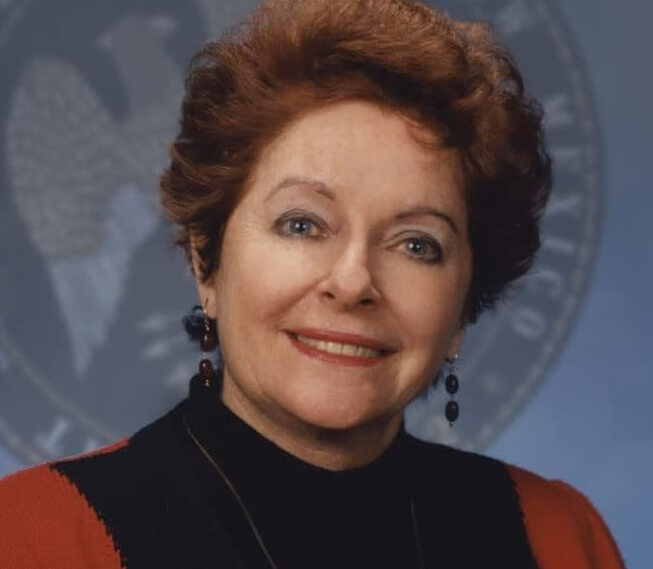
The first woman to serve in both houses of the New Mexico legislature, Pauline Eisenstadt has witnessed many exciting moments in the state's political history and made much of that history herself. Bachelor, U. Florida, 1960. Master of Science (National Science Foundation grantee), U. Arizona, 1965. Postgraduate U. New Mexico. Teacher, Arizona, 1961-1965, Prize ring (The), 1972-1973. Administrative assistant Institute Social Research U. New Mexico, 1973-1974. Founder, 1st executive director Energy Consumers New Mexico, 1977-1981. Host television program New Mexico Today and Tomorrow, 1992. Chairman consumer affairs advising committee Department Energy, 1979-1980.
Vice president technical board National Center Appropriate Technology, 1980. President Eisenstadt Enterprises, investments, 1983.
Member New Mexico House of Representatives, 1985-1992, chairwoman majority caucus, chair rules committee New Mexico House of Representatives, 1987, chair subordinate commission on children and youth, 1987. Member Executive Committee, vice chair private county National Conference State Legislators, 1987. Member New Mexico State Senate, 1996, member senate finance committee, committee higher education, committee economics development, science & technical, water & natural resources, electric deregulation committee, chair conservation committee. Vice chairman Sandoval County (New Mexico) Democratic Party, 1981.
Andy Garcia
Class of '74 · Entertainment: Actor, Producer

One of Hollywood's most private and guarded leading men, Andy Garcia has created iconic characters while at the same time staying true to his acting roots and personal projects.
Garcia was born Andrés Arturo García Menéndez on April 12, 1956, in Havana, Cuba. Garcia's family was relatively affluent. However, when he was two years old, Fidel Castro came to power, and the family fled to Miami Beach. Forced to work menial jobs for a while, the family started a fragrance company that was eventually worth more than a million dollars. He attended Nautilus Junior High School and later, Miami Beach Senior High School. Andy was a popular student in school, a good basketball player.
He studied acting with Jay W. Jensen. Jensen was a South Florida legend, counting among his numerous students, Brett Ratner, Roy Firestone, Mickey Rourke, and Luther Campbell. Following his positive high school experiences in acting, he continued his drama studies at Florida International University.
Soon, he was headed out to Hollywood. His first break came as a gang member on the very first episode of the popular TV series Hill Street Blues (1981). His role as a cocaine kingpin in 8 Million Ways to Die (1986) put him on the radar of Brian De Palma, who was casting for his gangster classic The Untouchables (1987). At first, he envisioned Garcia as Al Capone's sadistic henchman Frank Nitti, but fearing typecasting as a gangster, Garcia campaigned for the role of "George Stone", the Italian cop who gets accepted into Eliot Ness' famous band of lawmen. Garcia's next notable role came in Black Rain (1989) by acclaimed director Ridley Scott, as the partner of police detective Michael Douglas. He then co-starred with Richard Gere in Internal Affairs (1990), directed by Mike Figgis. In 1989, Francis Ford Coppola was casting for the highly anticipated third installment of his "Godfather" films. The Godfather Part III (1990) included one of the most sought-after roles in decades, the hot-headed son of "Sonny Corleone" and mob protégé of "Michael Corleone", "Vincent Mancini". A plum role for any young rising star, the role was campaigned for by a host of actors. Val Kilmer, Alec Baldwin, Vincent Spano, Charlie Sheen, and even Robert De Niro (who wanted the role changed to accommodate his age) were all beaten out by the up-and-coming Garcia. His performance was Oscar-nominated as Best Supporting Actor, and secured him international stardom and a place in cinematic history. Now a leading man, he starred in such films as Jennifer 8 (1992) and Hero (1992). He won raves for his role as the husband of Meg Ryan in When a Man Loves a Woman (1994) and gave another charismatic gangster turn in Things to Do in Denver When You're Dead (1995). He then returned in Night Falls on Manhattan (1996), directed by Sidney Lumet, as well as portraying legendary mobster Lucky Luciano in Hoodlum (1997). In perhaps his most mainstream role, he portrayed a cop in the action film Desperate Measures (1998). Garcia then starred in a few lower-profile projects that didn't do much for his career, but things turned around in 2001, with the first of many projects being his role as a cold casino owner in Ocean's Eleven (2001), directed by Steven Soderbergh.
Seeing his removal from Cuba as involuntary, Garcia is proud of his heritage which influences his life and work. One such case is his portrayal of renowned Cuban trumpet player Arturo Sandoval in For Love or Country: The Arturo Sandoval Story (2000). He is an extremely private man, and strong believer in old-fashioned chivalry. Married to his wife, Maria Victoria, since 1982, the couple has three daughters. One of the most talented leading men around, Garcia has had a unique career of staying true to his own ideals and thoughts on acting. While some would have used some of the momentum he has acquired at different points in his career to get rich off lightweight projects, Garcia has stayed true to stories and films that aspire to something more. But with a presence and style that never seem old, a respect from directors and film buffs, alike, Andy Garcia will be remembered for a long time in film history.
--Bio from IMDb
Induction Video
Ruth Wolkowski Greenfield
Class of '41 · Music/Education: Arts Visionary
A composer, concert pianist, and instructor of musical theory, history, and piano skills barely summarizes the long and illustrious musical career of this delightfully funny lady! Her light sense of humor brings smiles to all. At a tender age, Ruth keeps on going by holding monthly recitals of upcoming musicians in her Miami home she and her late husband, Arnold, inherited from her grandparents.
Her pioneering family settled in Key West in the late 1880s, but moved to Miami in 1924, where her parents chose Miami Beach for her schooling. Teenager Ruth was a gifted student in piano and perfected her French with Madame Brown while at Beach High. After her Masters degree in Beethoven and Schubert in 1946 from the University of Michigan, she was off to Conservatoire Nationale de Paris to continue learning from Nadia Boulanger.
Returning home to Miami, she became a music teacher, first in public schools, then at the new Dade "Junior" College, now called Miami Dade College (MDC). She created the Fine Arts Conservatory (FAC) in 1951, with her first student, piano prodigy and composer James Ford. An early proponent of integration, Ruth connected with Miami Herald's journalist Jack Bell, who wrote an article about 12-year-old James not being allowed to perform at the Miami Conservatory in the Miami Herald because James was a "Child of Color." Ruth continued to teach and run FAC while finding time to obtain a Doctorate in Musical Arts from the University of Miami.
Ruth composed numerous piano suites and attained a full professorship. She became Chair of the Dept. of Music at the Wolfson Campus at MDC, and created Lunchtime Lively Arts Series, organizing musicians to bring all types of Miami musical sounds to Flagler Street every week. "We started in 1972 and continued through the late 1980s. We later added the Lively Word Series, for poets, literary authors and others to speak and read from their works. Word moved inside Guzman Hall in late afternoons, so working people could avoid rush hour traffic going home. The Miami Book Fair came out from that series."
MDC's Wolfson Campus auditorium was dedicated to her in 2010, and the recital hall in the Dept. of Music was named "Greenfield Hall." Her many awards include "In the Company of Women Award," The Miami Herald's finalist for "Spirit of Excellence Award" and "Meritorious Award in the Arts." She is also a recipient of "Breaking the Glass Ceiling Award" from the Jewish Museum in Miami Beach.
Mark Medoff (in memoriam)
Class of '58 · Arts: Play & Screen Writer
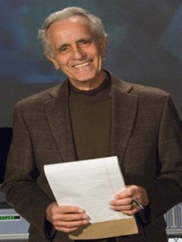
Medoff received his Bachelor of Arts degree from the University of Miami and his Master's from Stanford University. Medoff also received an honorary degree in 1981 from Gallaudet University.
Medoff's big breakthrough and most famous work was 1979's Children of a Lesser God, which won him the Tony, Drama Desk, and Laurence Olivier Awards for Best Play. Medoff was back on Broadway again with the staging of his play Prymate in 2005.
Medoff's screen credits include adaptations of his plays Red Ryder and Children of a Lesser God, for which he was nominated for an Oscar, BAFTA, and Writers Guild of America Award, Clara's Heart (for which he cast, and subsequently "discovered", Neil Patrick Harris), and City of Joy. In 2000, he produced and directed the documentary Who Fly on Angels' Wings, about a mobile pediatric unit traveling through the under-served regions of southern New Mexico, and the following year he directed the feature film Children on Their Birthdays, based on the short story by Truman Capote.
Medoff was co-founder of the American Southwest Theatre Company and head of the Department of Theatre Arts for nine years at New Mexico State University, where he was a professor for a total of twenty-seven years and taught Screenwriting and Acting for Film, Short Film Production, and Film Directing and Producing. He was also the Creative Director of the Creative Media Institute at NMSU, the film department at the university. The theater department is still the American Southwest Theater Company.
For one semester a year between 2003–06, he worked at Florida State University as a Reynolds Eminent Scholar in the School of Theatre. In the spring semester of 2008 he joined the faculty of the University of Houston School of Theatre and Dance as Distinguished Lecturer. He was the winner of the Kennedy Center Medallion for Excellence in Education and Artistic Achievement, given periodically to professionals in theater who also teach and mentor students.
In April 2019, he entered hospice care after battling cancer in his later years and suffering a fall. He died on April 23, 2019, from complications at age 79.
--Bio from Wikipedia
Kenneth Treister
Class of '48 · Arts: Architect, Sculptor, Author, Photographer
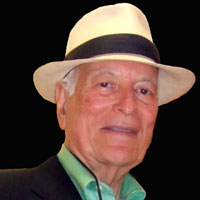
Kenneth Treister, FAIA is an American architect, architectural historian, sculptor, photographer, author and lecturer. He is a Fellow of the American Institute of Architects and is best known for the Holocaust Memorial he built in Miami Beach, Florida, as well as the Mayfair Shops and Hotel and the remodel of Temple Emanu-El.
In 1985, Treister received a commission to design, build, and sculpt a Holocaust Memorial in Miami Beach. The Memorial opened in February 1990 and welcomes thousands of visitors every year.
Kenneth Treister was born in 1930. His father, Arthur Treister, a real estate businessman, and his mother, Anita Treister moved to Miami Beach from Flushing, Queens when he was a baby. After World War II, Kenneth and his brother Leonard joined their father's business as Arthur Treister and Sons. He had a music scholarship to the University of Miami in 1948 and was elected president of the freshman class. He then transferred to the University of Florida, graduating in 1953 with a degree in architecture. He has lived in Miami-Dade County for most of his life, primarily in Coconut Grove.
The Kenneth Treister Collection is located in the University of Florida Digital Collection as part of its Architecture Archives. It includes architectural drawings, project files, correspondence, publications and writings, photographs, documentary films, and other materials spanning from the 1950s into the 21st century.
Another large collection of documents, photography, artifacts and articles about Treister's work can also be found in the Jewish Museum of Florida at Florida International University where a section in the permanent exhibition Mosaic is dedicated to Treister and the Holocaust Memorial. More than 50 newspapers and magazines throughout the world have published Treister's articles on architecture. He also shot four documentaries: The Architecture of the Maya, The Architecture of the Eastern Island, The Holocaust Memorial Miami Beach—the later one being awarded a 1999 Telly Award. He is the author of numerous books about art, history and architecture.
--Bio from Wikipedia
Neil Walk (in memoriam)
Class of '65 · Athletics: Basketball Star
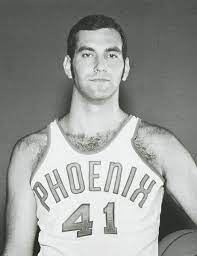
Neal Eugene Walk (July 29, 1948 – October 4, 2015) was an American college and professional basketball player who was a center in the National Basketball Association (NBA) for eight seasons during the late 1960s and 1970s, playing overseas afterward. Walk played college basketball for the University of Florida, and remains the Florida Gators' all-time rebounds leader. The Phoenix Suns picked Walk second overall in the 1969 NBA draft. Walk played professionally for the Suns, the New Orleans Jazz and the New York Knicks of the NBA.
Walk was born in Cleveland, Ohio to a Jewish family, and moved to Miami Beach, Florida, with his parents Al and Sylvia at the age of 6. He attended Miami Beach High School, and played high school basketball for the Miami Beach Hi-Tides, starting for the first time in his senior year. His high school team made the state semifinals. Walk accepted an athletic scholarship to attend the University of Florida in Gainesville, Florida, where he played for coach Tommy Bartlett's Florida Gators men's basketball team for three seasons from 1966 to 1969. In his junior season, Walk led the NCAA with 19.8 rebounds a game and average 26.5 points per game. As a senior team captain, he led the Gators to the 1969 National Invitation Tournament—their first-ever post-season tournament. When Walk graduated from Florida, he was the Gators' all-time leading scorer, and still maintains the team records for career rebounds (1,181), average points per game (20.8), and rebounds in a single game (31), among others. His No. 41 jersey remains the only number to have been retired by the Florida basketball program.
Walk was drafted in the first round (second pick overall) of the 1969 NBA draft by the Phoenix Suns, after they lost a coin toss with the Milwaukee Bucks for the number one pick, which turned out to be Lew Alcindor (later known as Kareem Abdul-Jabbar). In an interview with author Charley Rosen near the end of his life, Walk commented on his perception as one of the league's great "booby prizes," saying "I never paid attention to that bull----. How many guys would love to be the second overall pick?"
He played for the Suns from 1969 to 1974, averaging a career best 20.2 points per game and 12.4 rebounds per game in the 1972–73 season. Walk was traded to the then New Orleans Jazz, and subsequently traded to the New York Knicks, where he played for two seasons. Afterward, he went to play in Venice, Italy, then in Israel with Hapoel Ramat Gan, playing for the team for three seasons.
Walk is the only Suns player besides Charles Barkley to average 20 points and 12 rebounds in a season.
After Walk retired, he legally changed his first name to Joshua. In 1988, while Walk was living in Phoenix, it was discovered that Walk had a benign tumor enveloping his spine. Following surgery Walk was left in a wheelchair, from which he played wheelchair basketball for the L.A.-Phoenix Samaritans in the Southern California league of the National Wheelchair Basketball Association. In 1990 Walk was honored at the White House by U.S. President George H. W. Bush, as the "Wheelchair Athlete of The Year." He later worked for the Phoenix Suns in the Community Affairs department.
Walk is featured in the Miami Beach Senior High School Hall of Fame, a "Gator Great" in the University of Florida Athletic Hall of Fame, and was inducted into the National Jewish Sports Hall of Fame in 2006.
On October 4, 2015, Walk died of an unspecified blood disease.